
F. MENDELSSOHN – VIOLIN CONCERTO IN E MINOR, OP. 64
F. MENDELSSOHN – VIOLIN CONCERTO IN E MINOR, OP. 64
Few listeners can avoid a sense of astonishment—or even enchantment—upon hearing the opening bars of Mendelssohn’s Violin Concerto for the first time. The solo violin enters immediately, proud and captivating, unfolding a stream of rapid and exquisitely crafted bravura passages that draw the listener along with irresistible force. Even after countless hearings, audiences continue to be moved by and remember this unforgettable opening. Such an entrance was highly unusual for a concerto of its time, when the orchestra would typically require a substantial introduction before yielding the stage to the soloist.
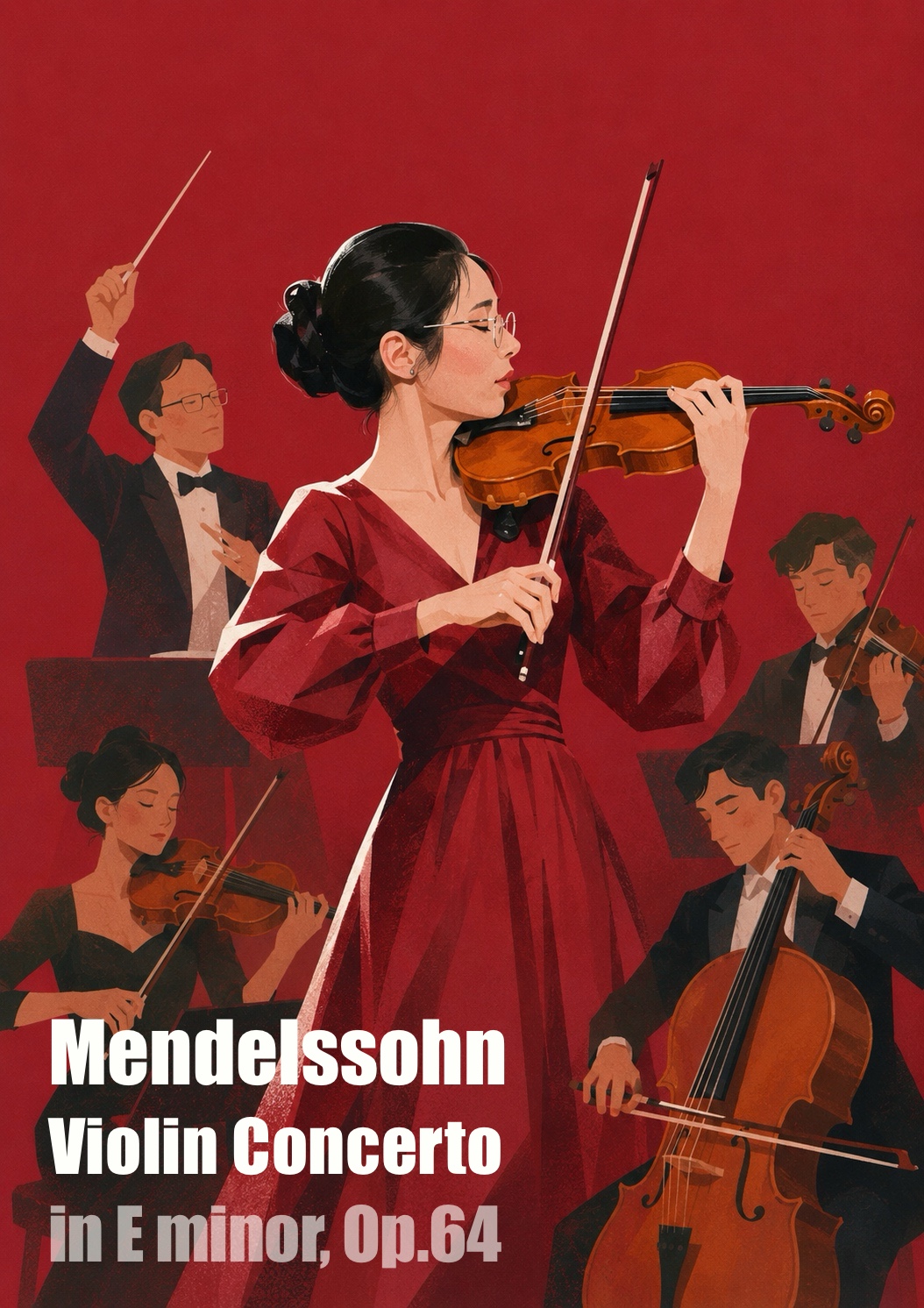
The second theme recedes like a distant wave, serene and contemplative in character. Introduced by the woodwinds, it unfolds above a sustained G played by the violin. The first movement, Allegro molto appassionato, contains another remarkable innovation. In a typical Classical concerto, the cadenza was improvised by the soloist and placed after the recapitulation, just before the final coda. Mendelssohn, however, composed the cadenza himself, making it an integral and inseparable part of the work. Significantly, it appears before the recapitulation of the principal theme.
A central aesthetic ideal of nineteenth-century music was the uninterrupted flow of emotional expression, blurring the boundaries between movements and sections. Mendelssohn connects the first and second movements with the gentlest of transitions: the B natural of the final chord in the first movement rises by a semitone to the C that opens the second. Thus, the passionate world of E minor gives way seamlessly to the lyrical tranquility of C major. The second movement, Andante, is cast in three parts. Its middle section, in A minor, is first presented by the orchestra before being taken up by the solo violin.
In the transition from the second movement to the finale, Allegretto non troppo – Allegro molto vivace, Mendelssohn briefly recalls the haunting shadow of the concerto’s opening theme, now tinged with melancholy and longing. Yet this darker mood quickly dissipates. A majestic orchestral fanfare sweeps away the lingering sadness, and the jubilant principal theme emerges in full brilliance. The movement follows a Sonata-Rondo design, often summarized as ABACABA. Here the violin part reaches extraordinary levels of virtuosity, demanding breathtaking speed, agility, and technical brilliance from the soloist.
This masterpiece was not composed overnight. Mendelssohn had been preoccupied with its principal melodic ideas since 1838 and spent six years refining the concerto before completing it. The work finally received its premiere in 1845.
The Violin Concerto in E minor, Op. 64, was Mendelssohn’s last concerto and remains one of the crowning achievements of the Romantic era, as well as one of the most beloved works ever written for the violin.
Mai Hanh, May 2025.
Related News
GIOACHINO ROSSINI – OVERTURE TO THE BARBER OF SEVILLE
Il barbiere di Siviglia (The Barber of Seville) is Rossini’s most famous comic opera, based on the play of the same name by the great French playwright Pierre-Augustin Caron de Beaumarchais. The story revolves around Count Almaviva, the young Rosina, and the clever barber Figaro.
SUBSCRIPTION CONCERT VOL. 183 ROSSINI – MENDELSSOHN – DVORÁK
The Vietnam National Symphony Orchestra is pleased to present Subscription Concert Vol. 183 under the baton of conductor Kim Xuân Hiếu, featuring violinist Hoàng Hồ Khánh Vân.
ANTONÍN DVOŘÁK: FROM THE NEW WORLD - SYMPHONY NO. 9
In the history of symphonic performance, there was one work that caused an entire concert hall to erupt in thunderous applause after every movement — not only after the first movement or at the conclusion of the piece — and led the composer himself to rise and bow repeatedly in gratitude to the audience. That composer was Antonín Dvořák, at the premiere of his Symphony No. 9 “From the New World” on December 16, 1893, in New York.
BARUCH BERLINER – ORIENTAL MARKET
“Oriental Market” by Baruch Berliner is an orchestral fantasy inspired by the composer’s walks in Turkic countries