
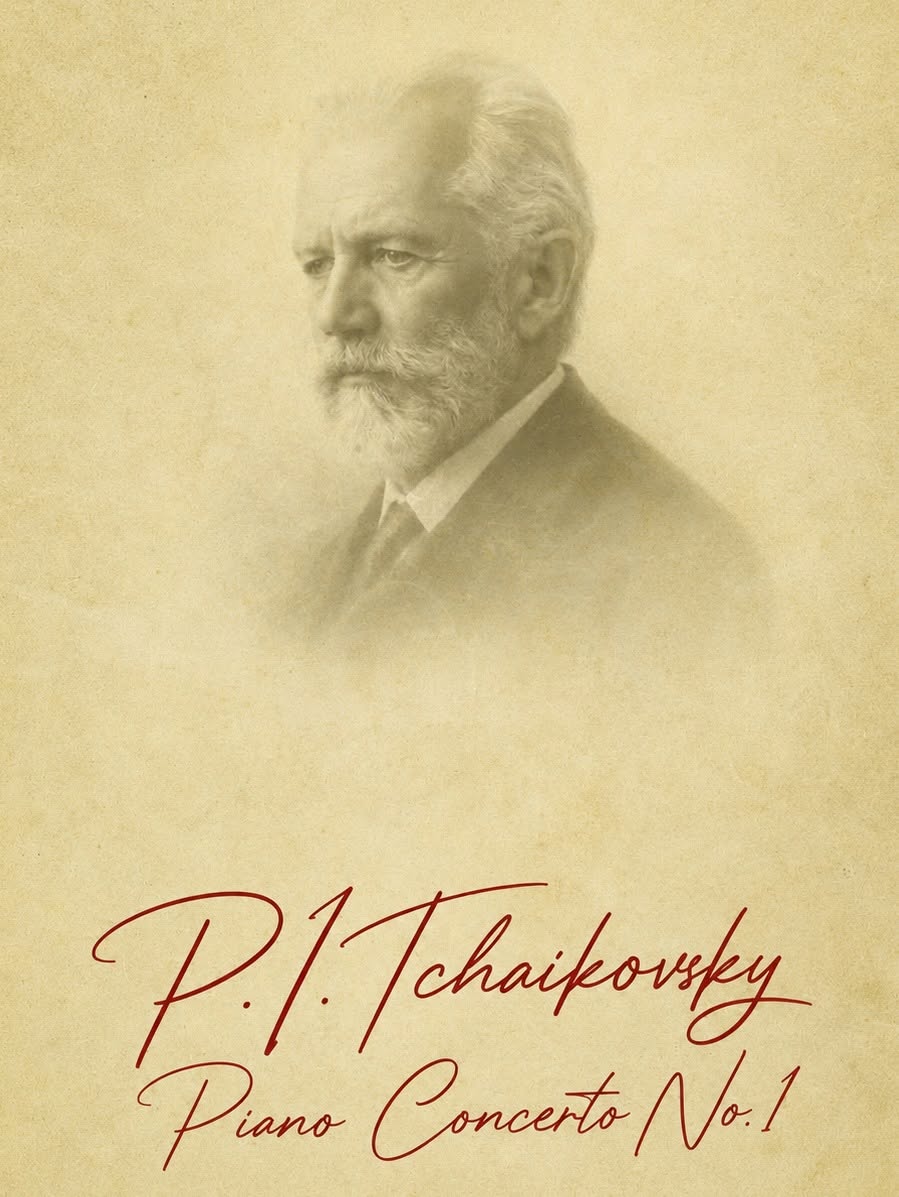
**P. I. TCHAIKOVSKY - PIANO CONCERTO NO. 1 - A REMARKABLE MASTERPIECE
Tchaikovsky’s Piano Concerto No. 1 is an extraordinarily special work. It is not only one of the great canonical masterpieces of the concerto repertoire in the history of Western classical music, but also a work that holds beautiful memories for generations of listeners. Its opening is instantly striking, with its heroic sound and unmistakable expression of a distinctly “Russian” spirit—one that cannot be confused with that of any other nation.
The melodies of this Concerto are perhaps deeply familiar not only to people from the former Soviet Union, but also to Russians and those who feel an affinity with Russia in the modern era. They belong to the generation who watched the opening ceremony of the 1980 Summer Olympics in Moscow and heard the music played at the final stage of the Olympic torch relay; to those of the next generation who were moved by the same melodies during the closing ceremony of the 2014 Winter Olympics in Sochi; and, most recently, to audiences who heard the work used in place of the Russian national anthem when Russian athletes were awarded gold medals at the 2020 Summer Olympics in Tokyo.
The opening of the first movement, Allegro non troppo e molto maestoso (“Fast, but not too fast, and very majestic”), resounds with three descending statements from the horns. The orchestra accompanies them with brilliant, firmly grounded chords, followed by the piano, which takes up these pillars of harmony as the orchestra unfolds the opening theme. The piano then continues to develop the theme, seemingly abandoning the orchestra and rushing into a world of its own self-questioning—a solitary monologue. This is a short cadenza, unusually placed within a concerto, appearing before the principal theme has even been fully presented. The orchestra then returns to “pull” the piano back to its feet with the majestic opening theme.
A new theme then emerges as the principal theme of the movement, Allegro con spirito (“fast and spirited”), presented by the piano. It is based on a strongly dance-like Ukrainian folk melody that Tchaikovsky had once heard from a blind street singer. This is followed by another melody in the clarinet, forming the second theme, and finally by a gentle, optimistic wave of sound led by the strings—the third theme of the movement. These melodies are passed continually from one instrument to another, while the piano responds with an ever-changing range of emotions.
The first movement is filled with passion and emotion, distinguished by its unusual formal design. Its departure from the conventions of contemporary concertos is perhaps most striking in the unconventional placement of the cadenza, which appears before the exposition of the principal theme.
The work was a bold innovation, moving away from the compositional traditions of its time. Perhaps this explains the dramatically different reactions of the two people whose opinions Tchaikovsky sought. Nikolai Rubinstein strongly opposed the work, dismissing it as “clumsy,” while the distinguished pianist and conductor Hans von Bülow admired it so deeply that he offered Tchaikovsky some of the most beautiful words of praise:
“…The concerto has displayed brilliance and is an outstanding achievement among your works. One thing is certain: you have enriched the world of music more than ever before. Throughout this remarkable work, there is a truly exceptional composition—noble, powerful, and filled with countless captivating moments; there is maturity in its form and style, in its design and execution, with harmonies so pleasing to the ear… that I could weary you by listing all the memorable moments for which I must thank the composer—not to mention the joy of performing it. In other words, this genuine jewel will earn you the gratitude of all pianists.”
Bülow gave the first performance of the Concerto in Boston in October 1875, where it was enthusiastically received by American audiences. A few years later, Nikolai Rubinstein overcame his initial reservations about the work and performed it himself. Tchaikovsky was “very, very happy” at his friend’s change of heart.
The work consists of three movements:
I – Allegro non troppo e molto maestoso – Allegro con spirito
(Fast, but not too fast, and very majestic – Fast and spirited)
II – Andantino semplice
(Slow and simple)
III – Allegro con fuoco
(Fast, with fire and passion)
…………
Mai Hạnh, August 2022
Related News
CLAUDE DEBUSSY - PRINTEMPS
The idea I had was to compose a work in a very special color which should cover a great range of feelings. It is to be called Printemps, not a descriptive Printemps, but a human one.
HISATADA OTAKA - FLUTE CONCERTO OP.30B
Otaka began sketching his Flute Concerto in 1948, when Japan was still under Allied occupation. In 1951, he revised and expanded the work for a larger orchestra. The concerto is a representative example of the flute concerto repertoire in twentieth-century Japan. Rich in lyrical expression, it combines technically demanding solo passages with gentle, flowing melodies, set within a balanced orchestral structure. The flute writing is both agile and richly varied in colour.
JOSEPH HAYDN – SYMPHONY NO. 94 “SURPRISE” UNEXPECTED PRANKS IN CLASSICAL MUSIC
Did you know that some classical composers loved to play little tricks on their audiences right in the middle of their own works? Sometimes, music gently draws us into a peaceful flow of emotions, only for the composer, in some charming and delightful way, to make us smile almost unconsciously with a leisurely musical phrase, a mocking horn call, or a sudden, thunderous outburst.
THE VIETNAM NATIONAL SYMPHONY ORCHESTRA BRINGS “THE HANOI SYMPHONY” TO LIFE IN “THE FLOW OF THANG LONG”
On the evening of 10 October 2026, the special artistic programme The Hanoi Symphony, themed The Flow of Thang Long, took place at Ho Guom Opera House in a solemn and deeply moving atmosphere. The event marked the 72nd anniversary of Hanoi’s Liberation Day (10 October 1954 – 10 October 2026) and the 27th anniversary of Hanoi being recognised by UNESCO as a City for Peace.